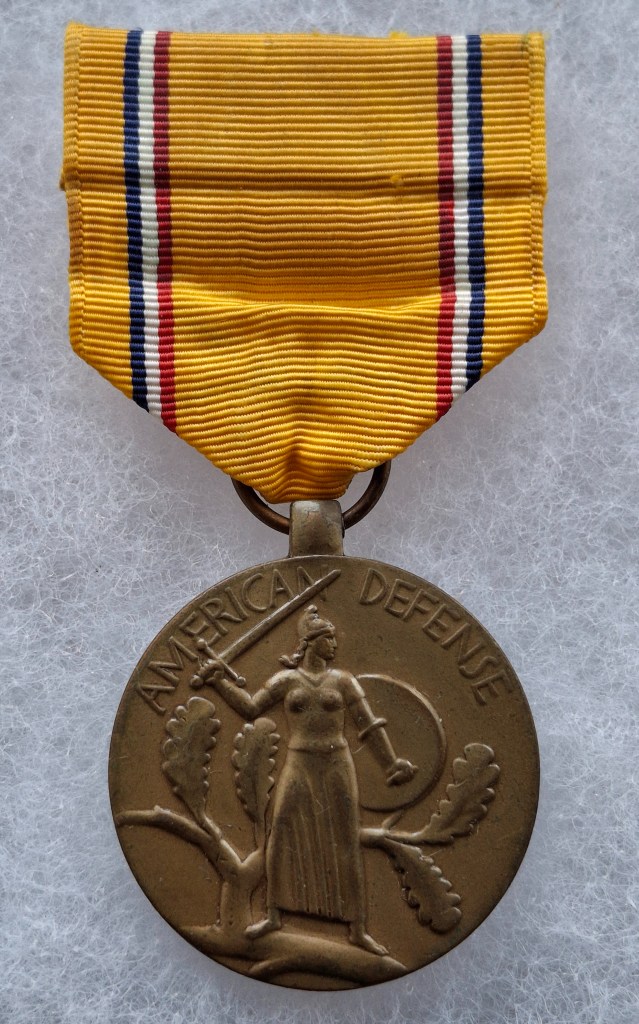
During a state of limited emergency from September 8th 1939 until December 7th 1941 a medal was issued to service personnel to boost their morale. The American defense service medal (ADSM) was proposed in February 1941 and officially established in June of the same year. The Army implemented the ADSM February 1942 with the Navy following in April.
The Army awarded the medal for 12 months service for the duration of the emergency but the Navy were less regulative and awarded the medal for active duty of at least 10 days.
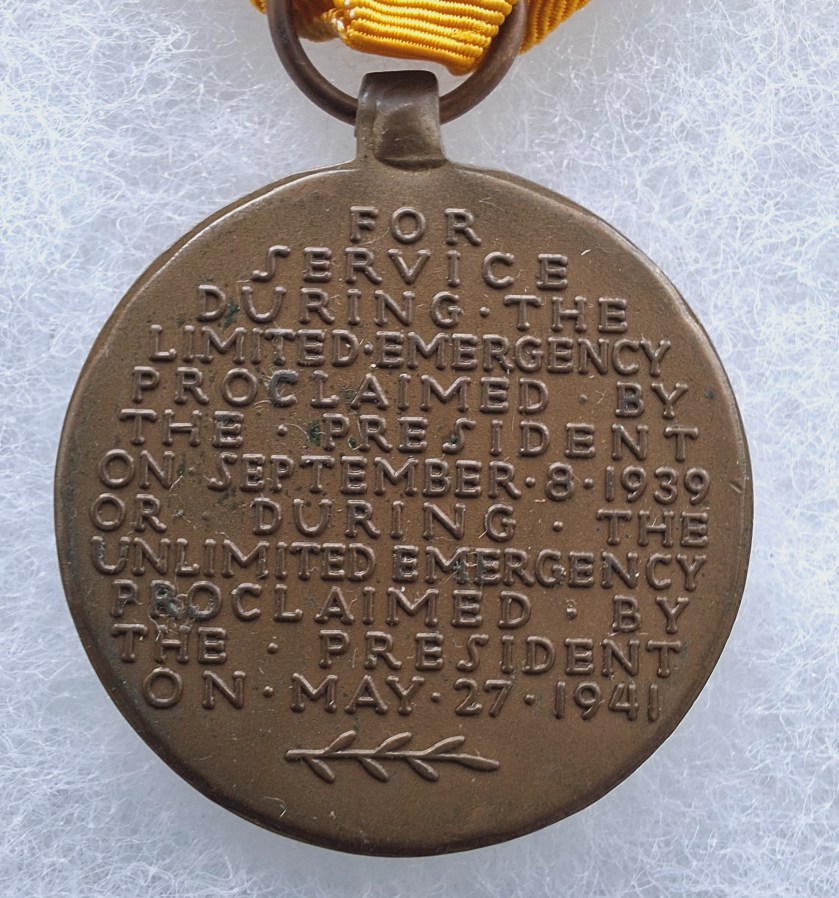
The obverse showing a representation of Liberty with sword and shield standing on a four branched tree with each branch representing the four services, the reverse having the inscription “For service during the limited emergency proclaimed by the President on September 8 1939 or during the unlimited emergency proclaimed by the President on May 271941”.
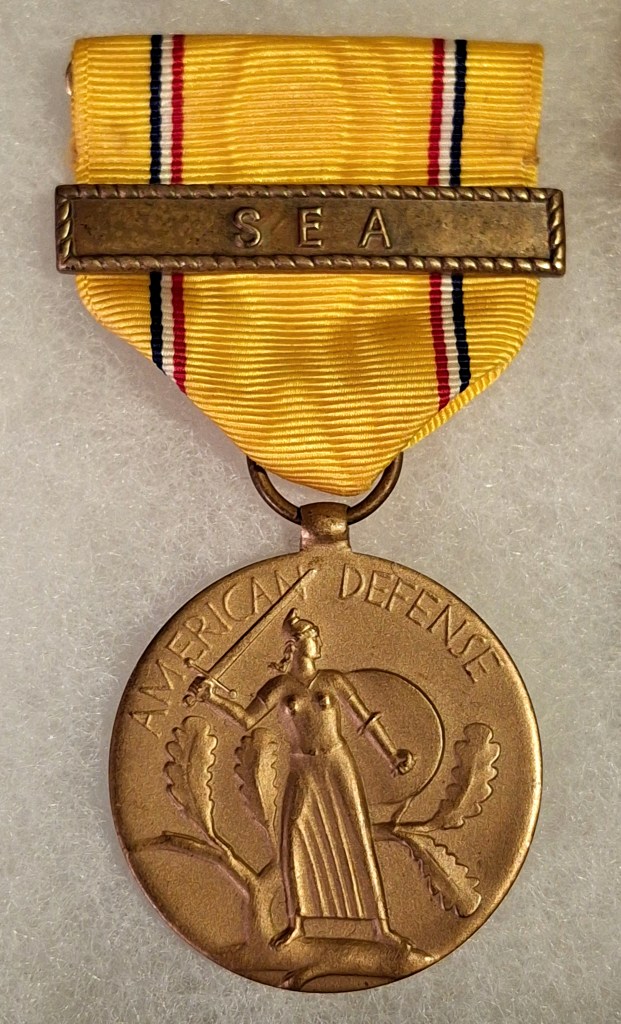
The basic medal was awarded for service within the Continental United States (CONUS) but both army and navy also awarded clasps for service outside CONUS.
Foreign Service clasp: Awarded by the army for outside the Continental United States to personnel assigned to an aircraft, vessel or other duties.
Fleet clasp: Navy issue to those service personnel on a vessel or in an aircraft squadron in the Pacific, Atlantic or Asiatic fleet.
Base clasp: Issued by the Navy for on-shore service at bases and naval stations outside of CONUS which included Hawaii and Alaska.
Sea clasp: A Coast Guard issue to members who undertook regular sea patrols and who did not qualify for the Fleet clasp. A lot rarer than the other three above.
For those personnel who were on board vessels in the Atlantic prior to the US entering the war a ribbon was issued with an A device attached (Navy, USCG and USMC only).
A bronze service star could also be awarded for a subsequent award or involvement in an operation as shown in this set of Army ribbons (note the 3 battle stars on the EAME ribbon). The bronze service star could not be worn alongside the A device.
Not a rare medal to find, especially original issue although there are later restrikes available. All original issue medals had the slot loop suspender attached with later issues having the ½ inch crimp.
Resource used:
The Call of Duty, (R James Bender Publishing 1994) John E Sandberg & Roger James Bender.
American War Medals & Decorations. (Viking Press, New York. Leo Cooper Ltd, 1st UK Edition 1973) Evans E Kerrigan.
(This article was first published on the Broadsword Military Forum July 2022).
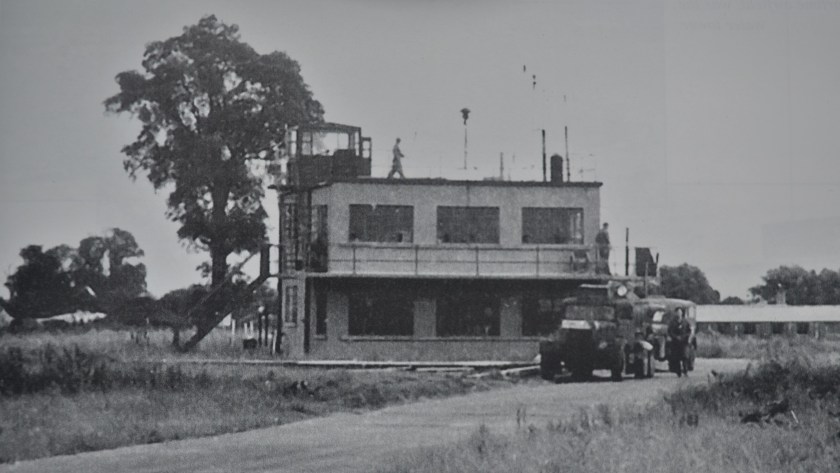
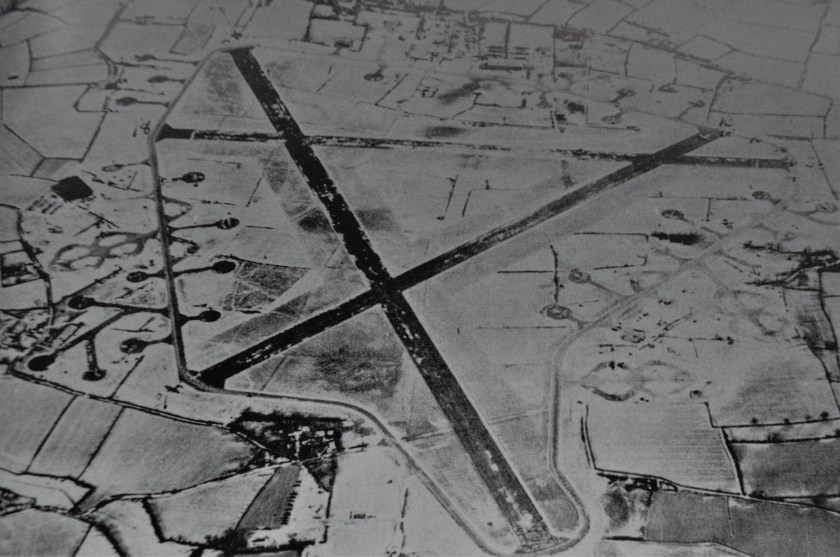
Located 3 miles east of Lavenham in Suffolk is the small village of Kettlebaston, just a few miles south of Rattlesden with both villages being south east of Bury St Edmunds. During the second world war RAF Rattlesden (Station 126) was built and occupied by the US Army Airforce 447th Bomb Group consisting of four bomb squadrons, 708th, 709th, 710th & 711th. The 447th was part of the 3rd Air Division flying B17’s and recognisable by its tail marking of the letter K in a square and had been at the airfield since December 1942 following its construction by George Wimpey & Co that same year. The 447th had been involved with bombing missions over Germany and occupied Europe. One such mission (No 152) planned for October 2nd 1944 was a primary target of an industrial armoured truck factory in Kassel, Germany. 458 B17s in total were dispatched by the 3rd AD to also include other industrial targets of opportunity at Wiesbaden and Gesecke.
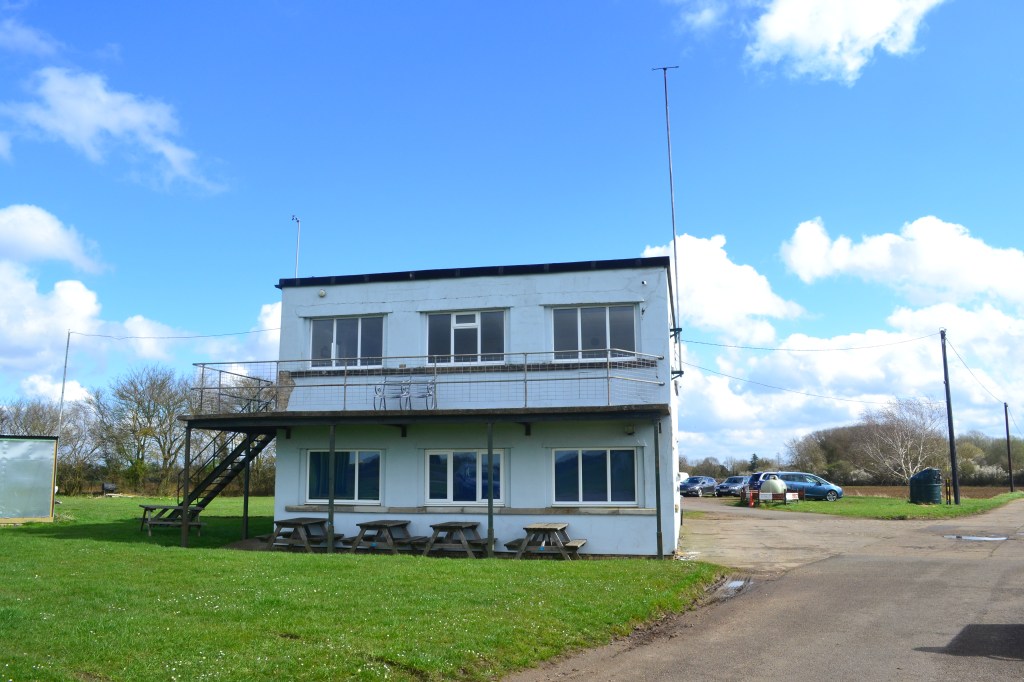
RAF Rattlesden Control Tower.
Following their briefing the crews would make their final checks 15 minutes before take off and would be at their stations in the aircraft and make final adjustments to any equipment. Take off would be at 30 second intervals and the aircraft would climb at a speed of 150mph, 400ft per minute. Assembly starting at around 500ft would consist of a V formation of 3 aircraft which would form into a squadron and finally assemble into a group. The basic principle was to form a combat box which would provide an all round defensive position for those defending the aircraft and also tighter grouping of bombs dropped. This assembly of the aircraft was fraught with danger especially that of a collision with other aircraft. Some of the crews said that this was the most perilous time when flying and felt safer once they were on their way even though they had Flak and the Luftwaffe to contend with once over the coast of mainland Europe!
Aerial view of the Airfield.
This is where this tragic story begins to unfold. A B17g of the 710th BS No 44-6460 was being piloted by 2nd Lt William M Wilder and was left wing man to Lt Eldon Henningsen who was right wing of a flight of 3. They were flying at 14,000 feet in formation and heading east towards the coast when Lt Henningson noticed a B17 off to his left nose diving towards the ground and then saw Wilder’s B17 start to bank away to the left with the tail section of a B17 stuck in the bomb bay. Wilder’s plane then began to nosedive towards the ground and disappeared from Henningsen’s site with no parachutes reported as opened.
The first B17 that Lt Henningsen saw go down was B17g 43-38245 of the 711th Bomb squadron piloted by Capt Clifford T Leach. Capt Leach who was on his second tour of duty having already completed 25 missions on his first tour was climbing through cloud cover when his plane collided with the underneath of Lt Wilders B17. The propellers from 8245 sliced off the plexiglass of 6460 and realising something was wrong Capt Leach pushed the controls of 8245 forward only for the tail section to wedge itself in the bomb bay of Lt Wilders plane 6460. This resulted in the tail stabiliser section to snap off and plunge Capt Leach and his crew down towards the ground with no one being able to escape the doomed aircraft.
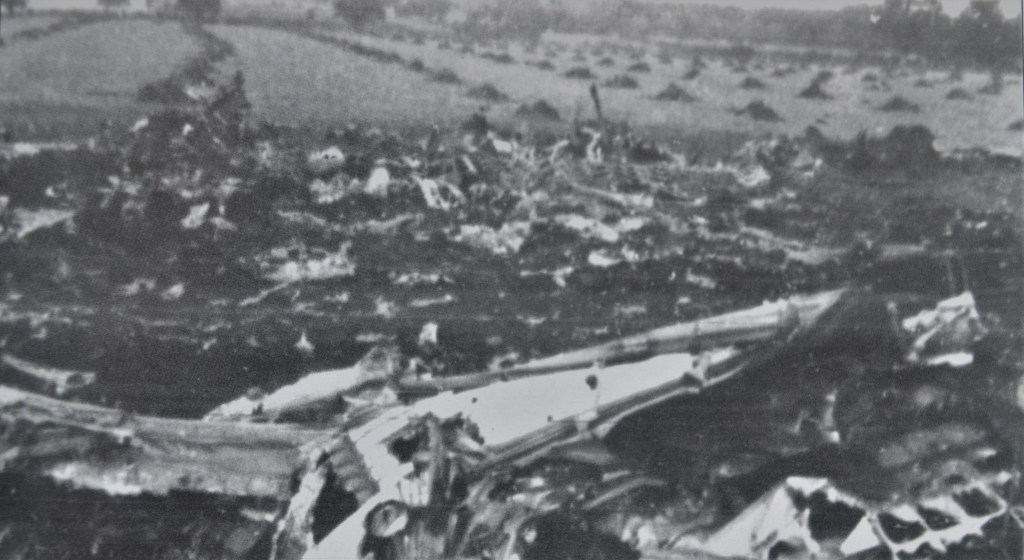
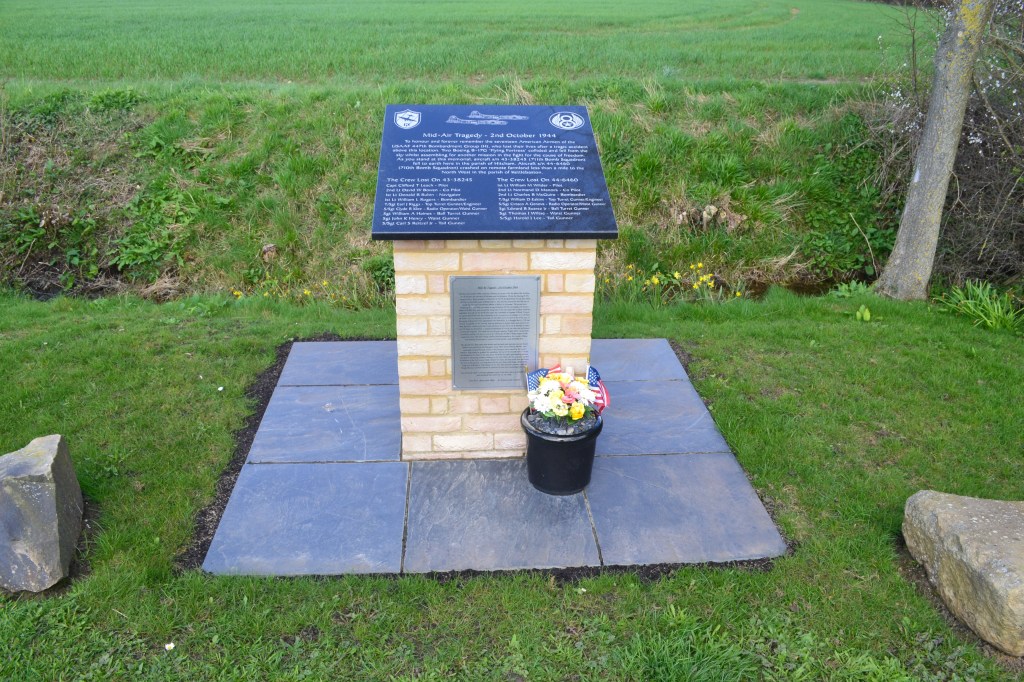
Leach’s B17g 43-38245 crashed at Wetherden Hall Farm, Hitcham with its tail section landing near to Kettlebaston Hall. Some reports say that the stabiliser was wedged into Wilders plane and as Leachs plan dropped forward the rest of the tail section was cut off by Wilders plane propellers.
8245 crash site at Wetherdon Hall Farm
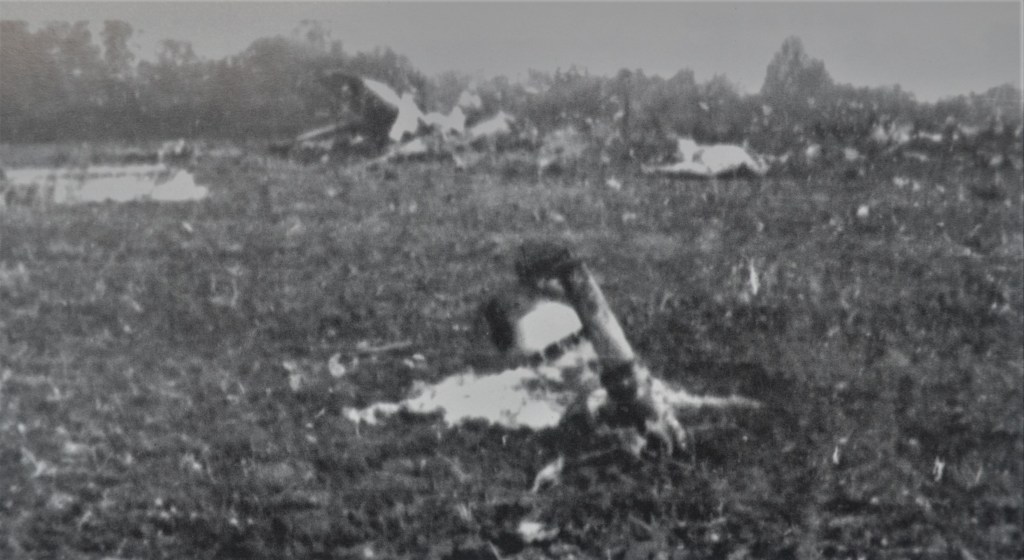
Wilders B17g 44-6460 crashed at Treacles Farm (now demolished) with eight of the crew killed and one survivor. The navigator 2nd Lt Eliot G Mishler grabbed a chute and exited the plane via the missing front plexiglass nose, attaching the chute on the way down and successfully opening it! He suffered a broken ankle on landing and was assisted by two farm boys only for Mishler to throw himself on top of these boys when the ammunition from the crash started to explode. Wilder and the Bombardier 2nd Lt Charles B McQuire also escaped the aircraft but their chutes failed to open. 2nd Lt Mishler was sent home and survived the war. I believe he passed away a few years ago.
Crew Names.
Wilder Crew. 710th BS B17g 44-64602nd
Lt William M Wilder – Pilot
2nd Lt Norman B Manock – Co-Pilot*
2nd Lt Eliot G Mishler – Navigator (survived)
2nd Lt Charles B McQuire – Bombardier*
Sgt William D Eakins – Top Turret/Engineer
Sgt Ciriaco A Genova – Radio Operator
Sgt Eduard B Suarez jr – Ball Turret Gunner*
Sgt Thomas J Wiltze – Waist Gunner
S/Sgt Harold J Lee – Tail Gunner
Leach Crew 711th BS B17g 43-38245
Capt Clifford T Leach – Pilot
2nd Lt David W Bowen – Co-Pilot*
1st Lt Donald B Rubin – Navigator*
1st Lt William L Rogers – Bombardier
Sgt Earl L Riggs – Top Turret/Engineer
S/Sgt Clyde R Klee – Radio Operator*
Sgt William A Haines – Ball Turret Gunner*
Sgt John K Henry – Waist Gunner*
S/Sgt Carl S Reitsel – Tail Gunner (S/Sgt Reitsel had survived a previous crash on 43-38245 along with two others in April 1944 at Thorpe Morieux and suffered burns but returned to flying status. The rest of the crew perished in the crash).
*Names of those buried at Madingley American Cemetery Cambridge England.
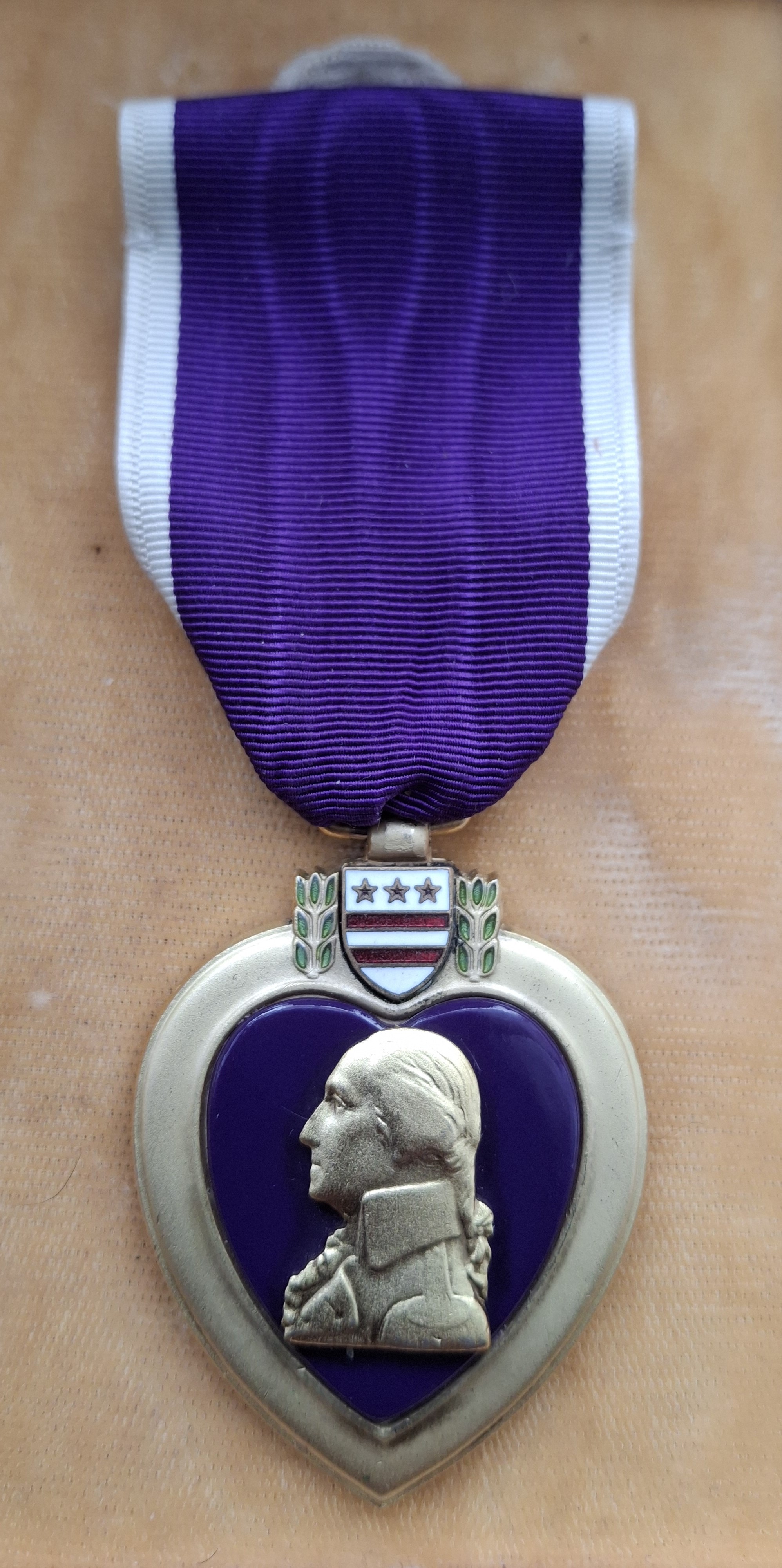
My interest in this tragic story stems from a purchase I made of a Purple Heart attributed to Harold J Lee Tail Gunner in B17g 44-6460.
I have done a certain amount of research and acquired an excellent book, “Pictorial Tribute to the men and aircraft of the 447th Bombardment Group (H) 1943-1945. Written by Derek Smith and published by East Anglia Books to whom I am indebted to Marilyn Bishop reference copyright of pictures.
Harold J Lee was born 4th January 1919, Oregon. Enlisted San Francisco, Ca, 13th Jan 1942. Army serial number 19065386. Originally in the Medical Admin Corp he then transferred to the US Army Air Corp. He was a resident of Butte County, California and his occupation was that of an Actor but this may be incorrect as his two older brothers were Doctor’s? His ethnicity was that of Chinese American and he was single with no dependants. His remains were interred originally at Madingley, Cambridge, England but in 1948 were returned to the United States for burial at Golden Gate National Cemetery, San Bruno, San Mateo County, Ca, 22nd July.
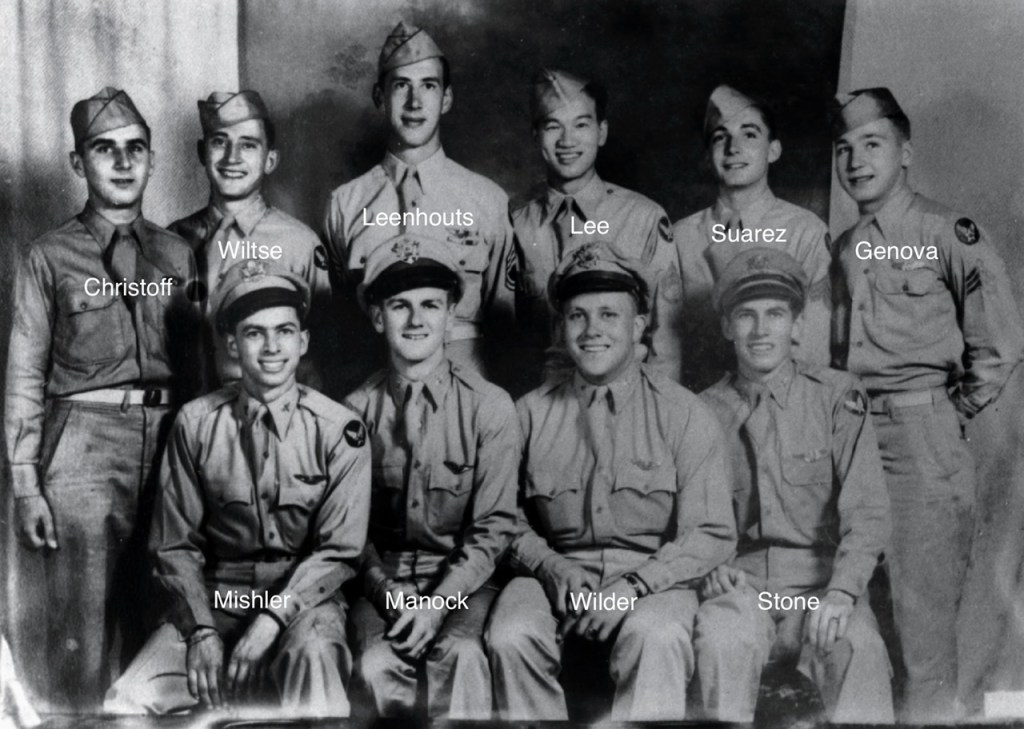
Harold J Lee is 3rd from the right back row in the picture of Wilder’s crew. First thing that strikes me is how happy they all look and how young they all are, Lee being just 25 when he died. Wilder is 2nd from the right and Manock the co-pilot is 2nd from the left front row. They all must have realised every time they climbed aboard that plane the dangers involved, yet they still did it and some even signed on for a second tour! Massive respect for not only these two crews that perished in this tragic accident but all those that volunteered for duty in the mighty 8th Air Force. The Wilder Crew picture above has 10 crew but this was reduced to 9 with the Radio Operator becoming a waist gunner when required. From the names identified on the picture, Christoff, Leenhouts and Stone (who was injured during their second mission) were reassigned and replaced with Lt McGuire who replaced Stone and Sgt Eakins who replaced Leenhouts. The crew arrived at Rattlesden 24th July 1944 and the 9 man crew flew their first combat mission 16th August. Mighty Eighth War Diary (Roger A Freeman) indicates that the 3rd AD sent 234 B17s to primary oil installation targets at Zeitz and Rositz south of Leipzig. With thanks to Kevin Harrington from North California for the updated Wilder crew picture.
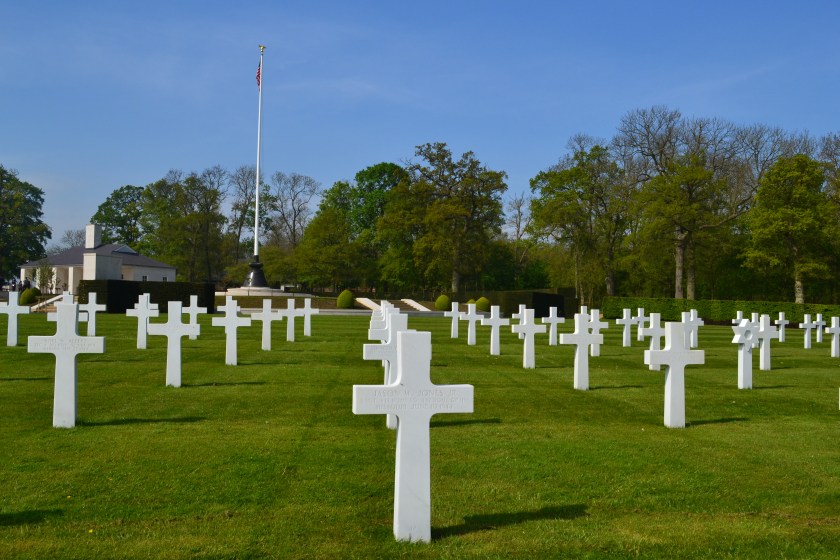
There are eight graves at the American Cemetery at Madingley, Cambridge, England. These are some of the crew members of the B17’s that collided over Kettlebaston, October 2nd 1944. I visited Madingley, August 2022 to pay my respects.
My thanks again go to Marilyn Bishop of East Anglia Books of Stansted. Essex for assistance with some of the material above and also the staff at the American Cemetery, Madingley, Cambridge, England for their help in finding the graves.
Reference material I have used:
Pictorial Tribute to the men and aircraft of the 447th Bombardment Group (H) 1943-1945. Derek Smith and published 2006 by East Anglia Books, Stansted, Essex, CM24 8UZ.
The Mighty Eighth in the second world war by Graham Smith. 2001 published by Countryside Books, Newbury, Berkshire.
USAAF Handbook 1939-1945. Martin W Bowman 1997 Sutton Publishing Ltd, Phoenix Mill, Thrupp, Stroud, Gloucestershire GL5 2BU.
Mighty Eighth War Diary, Roger A Freeman, 1981, Janes Publishing Co Ltd, 238 City Road, London EC1 2PU.
Harold J Lee’s military information supplied by Daniel Griffin, Shomakersville, Pennsylvania. USA.
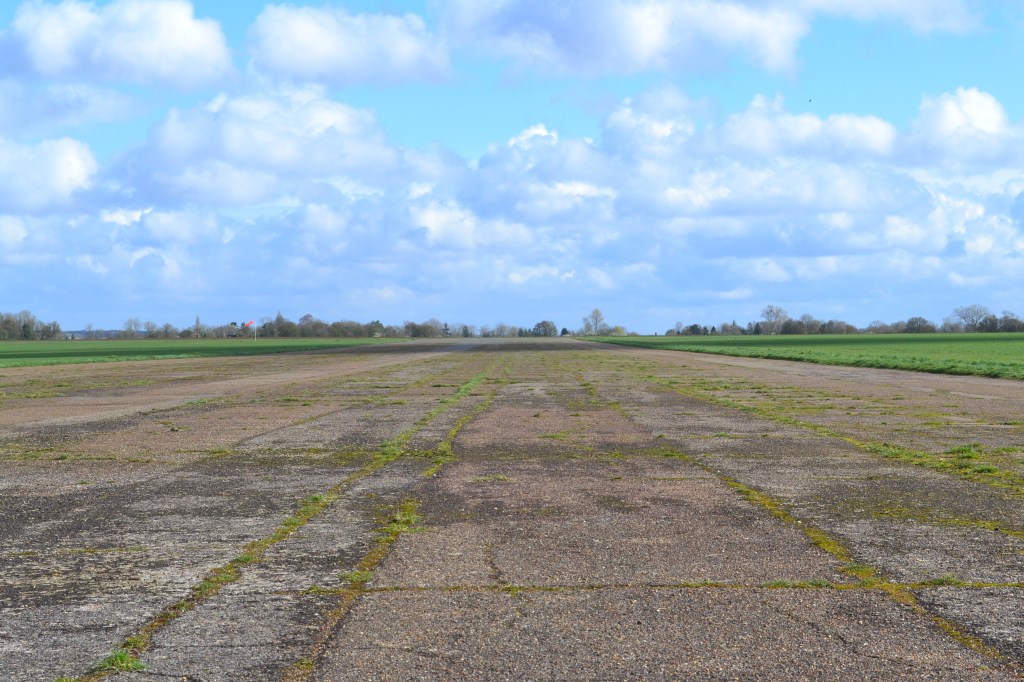
Update April 2024. I had the pleasure of a visit to Rattlesden Airfield in Suffolk whilst on vacation there end of March 2024 and was allowed to drive onto the runway and also visit the control tower which is run by the Rattlesden Glider Club. Charles Portway was an excellent host and I am indebted to him for showing me around the airfield and also the small museum they have in the control tower. I also visited the village of Kettlebaston to see the memorial to both aircrews at Wetherden Hall Farm.
A poem I have written in memory of the 447th and Rattlesden Airfield.





 usmilawards.uk